Today I spent time thinking again about the war in Ukraine.
It has now entered its fifth year.
Four years of continuous fighting. That alone feels heavy.
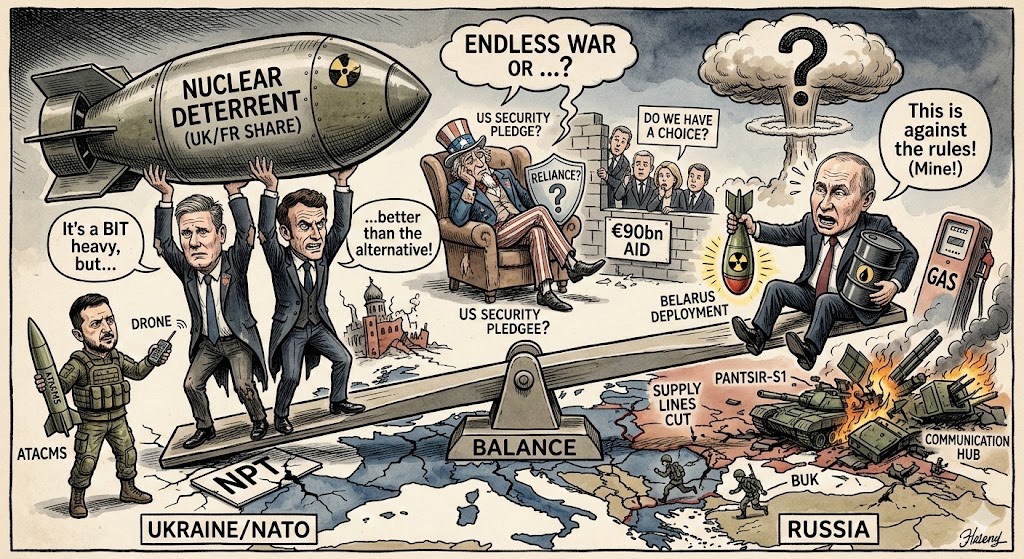
Recently, the nuclear debate has returned.
Some reports — mainly from Russian sources — claim that the United Kingdom and France may consider transferring nuclear warheads to Ukraine. There is no official confirmation. Still, even the discussion itself feels significant.
France operates the submarine-launched ballistic missile system M51.
If small nuclear warheads connected to that system were ever considered for transfer, it would mark a historic shift.
Russia reacted strongly.
President Vladimir Putin warned that if Ukraine becomes a nuclear-armed state, Russia would respond with all available weapons. That is not symbolic language. It is direct.
Russia also argues that such a move would violate the Treaty on the Non-Proliferation of Nuclear Weapons.
However, Russia has already deployed nuclear weapons in Belarus. The political and legal situation is complex.
Security Questions
I keep asking myself:
If NATO membership does not happen soon, what guarantees Ukraine’s long-term security?
Traditional models include:
NATO Article 5 Bilateral defense agreements Long-term military aid packages
But some believe these may not fully deter future aggression.
During the Cold War, nuclear deterrence prevented direct superpower war.
The logic of mutual destruction created fear — and stability.
Is Europe slowly returning to that logic?
Battlefield Developments
At the same time, Ukraine continues military pressure.
Ukraine recently used ATACMS again.
This system was supplied during the administration of Joe Biden.
ATACMS is precise and fast, making interception difficult.
Ukraine has also struck Russian air defense systems such as:
Pantsir-S1 Buk-M1
These systems are expensive and not easy to replace.
Repeated losses gradually weaken defensive coverage.
In addition, Ukraine received Swedish airborne early warning aircraft, the Saab 340 AEW&C.
This strengthens radar detection and coordination.
The battlefield environment appears to be shifting, slowly but steadily.
Strategic Reflection
Europe seems to be recalculating risk.
If Ukraine were to fall, pressure could move toward:
The Baltic states Poland
In that case, NATO would face direct confrontation with Russia.
Some strategists argue that strengthening Ukraine’s own deterrence now may be less risky than a wider war later.
I do not know whether nuclear sharing will actually happen.
The legal, political, and military barriers are extremely high.
But the existence of this debate tells me something important:
The old security framework no longer feels stable.
Closing Thought
Perhaps this war will not end with small adjustments.
Perhaps it requires a structural shift in European security.
It feels like history is moving slowly — but decisively.
Uncomfortable.
Uncertain.
But undeniably real.